Applying for an Individual Taxpayer Identification Number (ITIN) involves a structured process managed by the IRS, centered on completing Form W-7. This application requires submitting specific documentation demonstrating both identity and foreign status as part of the package. The submission requirements and conditions are governed by IRS rules, which applicants must follow carefully to ensure their application is properly reviewed. This guide covers the key steps and details you need to know when preparing your ITIN application from start to finish.
What is an ITIN?
An Individual Taxpayer Identification Number (ITIN) is a tax processing number issued by the Internal Revenue Service (IRS). It is intended for individuals who need a U.S. taxpayer identification number but are not eligible to obtain a Social Security number (SSN). The ITIN is used for federal tax-related purposes, including situations in which an individual must be identified on a federal tax return or other tax filing.
An individual may need an ITIN because of a federal tax filing or reporting requirement, even though the individual cannot use an SSN. Applicants generally request an ITIN by submitting Form W-7 with documentation that supports their identity and foreign status. The correct reason for applying must also be identified so the IRS can evaluate the request under the applicable rules. For current eligibility and application details, review the IRS’s Individual taxpayer identification number (ITIN) information.
An ITIN has a limited purpose. It is a tax processing number, not a general-purpose identification document, and it is not issued for non-tax purposes. Having an ITIN does not change an individual’s eligibility for an SSN or create rights beyond federal tax administration. Applicants should therefore use it only where an ITIN is required or permitted for a tax-related matter.
Overview of the ITIN Application Process
Applying for an Individual Taxpayer Identification Number (ITIN) generally involves completing Form W-7, gathering supporting documentation, and submitting the application to the IRS for review. The process begins by identifying the appropriate reason or category for the application, as the information required on Form W-7 depends on the applicant’s circumstances.
Applicants must provide documentation that establishes their identity and foreign status. Document requirements can vary, so applicants should review the IRS guidance on how to apply for an ITIN before submitting anything. In many cases, Form W-7 is submitted with a federal income tax return, although exceptions may apply under IRS rules.
After receiving the application package, the IRS reviews Form W-7 and the supporting documentation. The IRS—not a preparer or other assisting organization—makes the determination and processes the application. Applicants should ensure the form is complete, the reason for applying is appropriate, and the documentation is included before submission. Review the form carefully before submission and follow the current IRS instructions.
For practical guidance through the preparation and submission steps, explore ITIN application assistance.
Completing Form W-7
Form W-7 is the IRS application used to request an Individual Taxpayer Identification Number (ITIN). Complete the form carefully and use the current Instructions for Form W-7 to understand what each section requires. The form generally asks for identifying information, the reason for applying, and details needed to support the applicant’s foreign status and identity.
A key step is selecting the correct reason category. The category should match the applicant’s circumstances and explain why an ITIN is needed. Review the IRS instructions and supporting-document requirements before submitting the application. An incorrect or unsupported reason may lead to complications in processing the application.
In most cases, Form W-7 must be submitted with a federal income tax return. The tax return and Form W-7 should be prepared together so the application is connected to the filing that supports the request. However, the IRS recognizes specific exceptions to the tax-return requirement. If an exception applies, follow the instructions for documenting that exception rather than attaching a return unnecessarily.
Include the required proof of identity and foreign status with the form. Requirements can vary according to the applicant’s circumstances, so review the IRS guidance before sending the complete package.
Preparing Your ITIN Application Package
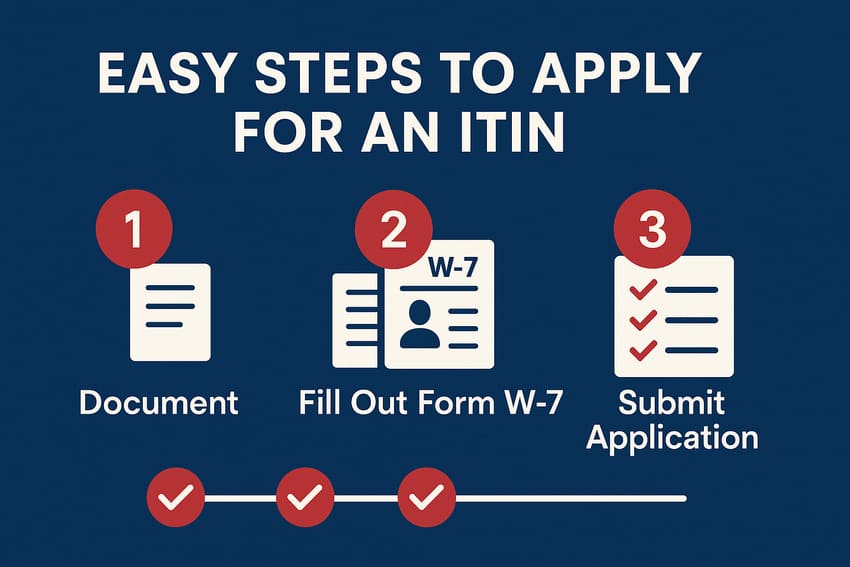
Before submitting an ITIN application, assemble the complete package rather than sending Form W-7 by itself. The package generally includes:
- A completed Form W-7, Application for IRS Individual Taxpayer Identification Number
- Documentation establishing the applicant’s identity and foreign status
- A federal income tax return, unless an exception to the tax-return requirement applies
The supporting-document requirements can vary depending on the applicant’s circumstances. Review the IRS ITIN supporting documents guidance to confirm which documents are acceptable and whether the documents must be submitted in a particular form. Avoid relying on an informal or outdated document list.
The tax return is generally included with Form W-7 as part of the application package. This allows the IRS to process the ITIN request with the related federal tax filing. If the applicant qualifies for an exception, the required documentation and submission approach may differ, so the applicable IRS instructions should be reviewed carefully.
Before mailing or submitting the package, check that Form W-7 uses the appropriate reason or category, all required sections are complete, and the information is consistent across the form, tax return, and supporting documents. Keep copies of the completed application and materials for your records, and verify the latest IRS instructions before submission.
Required Documentation for Identity and Foreign Status
An ITIN application generally requires Form W-7 and supporting documentation that establishes both your identity and foreign status. The documents must correspond to the information reported on the application, and requirements can vary based on the applicant’s circumstances. Review the IRS ITIN supporting document requirements before submitting your package.
A passport is generally the most comprehensive option because it can serve as a stand-alone document when it verifies both identity and foreign status. Using a passport alone does not eliminate the need to complete Form W-7 or provide any other item required for the specific application. If the passport does not establish the information the IRS requires for the applicant’s situation, additional supporting documentation may be necessary.
Dependent applicants should pay particular attention to the documentation rules. The IRS may require additional documents for a dependent applicant, including documentation needed to verify the dependent’s identity and foreign status. The required materials can also depend on the dependent’s circumstances, so applicants should not assume that the documentation used for another family member will be sufficient.
Review the form carefully before submission and follow the current IRS instructions.
Submitting an ITIN Application
Applicants generally submit an ITIN application by mailing Form W-7 to the IRS with the required proof of identity and foreign status. The package may also need supporting documentation connected to the application. Because document requirements can vary based on the applicant’s circumstances, review the current IRS instructions for applying for an ITIN before sending the package. Use the mailing address provided in the current Form W-7 instructions.
Some applicants may be able to receive in-person assistance through an IRS Taxpayer Assistance Center that offers ITIN services. These locations can help with the application process and document review services available through the IRS. Appointment and service availability can vary, so confirm that the location provides ITIN assistance before visiting.
Applicants may also work with an Acceptance Agent (AA). An AA can provide assistance with preparing or reviewing an application. A Certifying Acceptance Agent (CAA) is an Acceptance Agent authorized to authenticate eligible supporting documents within IRS rules and may assist with reviewing and submitting the application package. Neither an AA nor a CAA can guarantee approval or faster IRS processing.
Explore how we can assist with your ITIN application.
Role of Acceptance Agents and Certifying Acceptance Agents
Acceptance Agents (AAs) and Certifying Acceptance Agents (CAAs) are authorized to help applicants prepare and submit ITIN applications. Both may provide guidance on Form W-7, review an application package, and help ensure that the materials are organized for submission to the IRS.
The primary distinction is how supporting documents are handled. An AA may assist with the application process, but the applicant generally remains responsible for providing the required documentation directly under IRS procedures. A Certifying Acceptance Agent (CAA) has additional authority to authenticate eligible supporting documents within IRS rules. This means that while a CAA can assist with the application process, the specific requirements depend on the applicant’s circumstances and the documents provided.
A CAA may review the Form W-7 and supporting materials, complete the required certification process, and assist with submitting the application. However, neither an AA nor a CAA can guarantee approval or promise an error-free application. The IRS remains responsible for reviewing the application and making the final determination. For current requirements, consult the IRS guidance on how to apply for an ITIN.
Understanding IRS Processing Times
The IRS generally takes about 7 weeks to process an ITIN application and notify the applicant of its status. This is an estimate rather than a guaranteed deadline. Processing may take longer during peak periods, such as times when the IRS receives a higher volume of applications. Applicants should generally allow 9 to 11 weeks if the application is submitted from overseas or during a peak processing period. The timeframe can also depend on whether the IRS receives the required Form W-7 information and supporting documentation needed to review the application.
While waiting, keep a copy of the submitted application materials for your records and allow the full estimated timeframe before drawing conclusions about the application’s status. Neither an Acceptance Agent nor a Certifying Acceptance Agent can guarantee an error-free application. Review the form carefully before submission and follow the current IRS instructions.
For the most current guidance, review the IRS’s information on how to apply for an ITIN, including any updates to processing-time estimates or submission instructions.
Practical Tips for Preparing Your ITIN Application
Accuracy matters when completing Form W-7. Select the reason or category that fits your circumstances, and make sure the information on the form is consistent with your supporting documentation. An incorrect reason, incomplete response, or mismatch can require clarification and delay the review of your application. Before submitting, review the IRS Instructions for Form W-7 and use the current version of the form.
Document preparation also requires care. Requirements can vary based on an applicant’s circumstances, so avoid relying on a general document list without checking the applicable IRS requirements. Confirm that your documents establish both identity and foreign status and that they are eligible for the submission method you plan to use. If a federal tax return is required with the application, include it unless an applicable exception applies.
Use this final checklist:
- Complete every applicable part of Form W-7.
- Confirm the selected reason or category.
- Gather the required identity and foreign-status documentation.
- Include the federal tax return when required, or confirm the applicable exception.
- Review the entire package against the current IRS instructions before submitting.
Learn more about professional assistance with your ITIN application.