ITIN for Non-Residents: Who Qualifies and How to Apply
In brief
Nonresident aliens can get an ITIN when they have a valid U.S. federal tax purpose and are not eligible for a Social Security Number. Common reasons include filing a U.S. tax return, claiming a refund, receiving treaty benefits or qualifying as a spouse or dependent. You can apply from outside the United States using Form W-7. This guide explains eligibility, reason boxes, required documents, application steps and processing times.
An ITIN for non residents is available when you live outside the United States, or are only in the country temporarily, and still have a federal tax purpose. The IRS issues Individual Taxpayer Identification Numbers to nonresident aliens who must file a US return, claim a refund or a tax treaty benefit, or who are the spouse or dependent of someone with a US tax purpose. You do not need to live in the United States, but you do need a tax reason.
This guide explains who counts as a nonresident, which W-7 reason box applies, what to send and what to expect.
At a glance
| Question | Answer |
|---|---|
| Can a nonresident get an ITIN? | Yes, if there is a federal tax purpose |
| Do I need to live in the US? | No |
| Which reason boxes are common? | a (treaty benefit) and b (nonresident filing a return) |
| Do I need an SSN first? | Only if you are eligible for one; an ITIN is for those who are not |
| How long does it take from abroad? | 9 to 11 weeks according to the IRS |
| Does it give work rights? | No |
Who counts as a nonresident alien
For tax purposes, a nonresident alien is someone who is neither a US citizen nor a US resident alien. Residency for tax is decided by your green card status or by the substantial presence test, which counts days spent in the United States. The IRS reason box c covers people who are resident aliens under the days-present test and file a US return. Everyone else who is outside the US citizen and resident group is generally a nonresident alien. The IRS explains the details in Publication 519, listed in the sources below.
When a nonresident needs an ITIN
A nonresident alien can apply when:
- They must file a US return. For example, because they have income connected with a US trade or business.
- They are filing only to claim a refund. The W-7 instructions describe box b as covering refund-only filers.
- They need an ITIN to claim a tax treaty benefit. This is box a, "nonresident alien required to get an ITIN to claim tax treaty benefit".
- They are covered by an exception. Certain passive income, such as rental income or interest paid by a US source with information-return reporting, can qualify under exception 1 of box h.
- They are a spouse or dependent of a US citizen or resident alien, or of a nonresident alien in a qualifying situation.
If none of these applies, the IRS does not issue an ITIN just because you are a foreigner or want one for another purpose. See do I need an ITIN.
Choosing the right reason box
| Situation | Reason box |
|---|---|
| Treaty benefit that requires an ITIN, with no filing requirement | a |
| Nonresident alien filing a US federal return | b |
| Dependent or spouse of a US citizen or resident alien | d or e |
| Nonresident alien student, professor or researcher | f |
| Other, including the five listed exceptions | h |
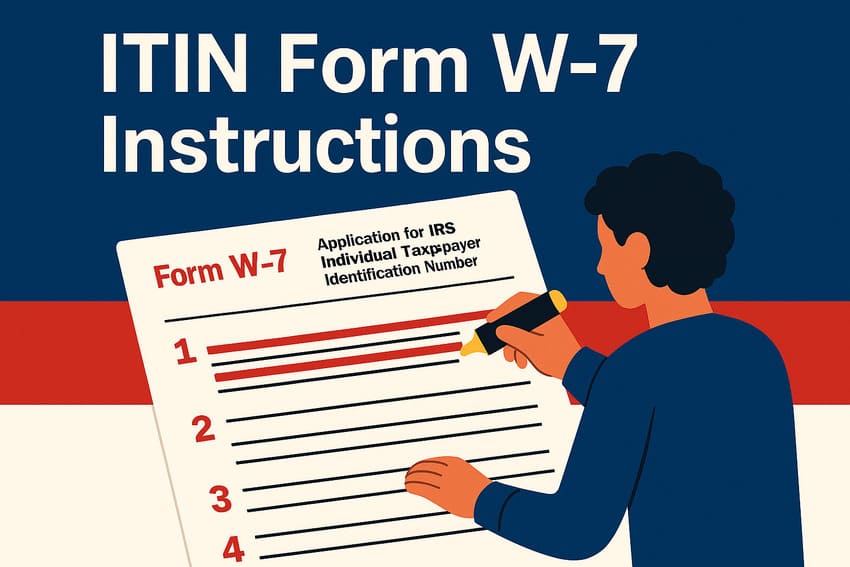
A wrong box is a common cause of rejection. The treaty benefit box is a; box b is for nonresident aliens filing a return. See the Form W-7 instructions guide for each line.
Documents a nonresident should send
A valid passport is the only document the IRS accepts on its own because it proves both identity and foreign status. Without a passport, you need a combination from the IRS list. Send originals or copies certified by the issuing agency, since the IRS does not accept notarized copies. The ITIN documents checklist lists them all.
How to apply as a nonresident
- Confirm your tax reason and reason box.
- Prepare your return. Most applicants attach Form 1040-NR to the W-7, unless an exception applies.
- Prepare documents, or arrange for an acceptance agent to authenticate them.
- Submit by mail to the IRS ITIN Operation or through an agent. A Taxpayer Assistance Center requires you to be in the United States.
- Wait. The IRS says 9 to 11 weeks when you apply from overseas.
The full steps from abroad are in how to apply for an ITIN from outside the US.
Nonresident and not sure which box applies? Start your ITIN application and have your reason box, return and documents reviewed before submission. See also our ITIN application service.
What the ITIN does and does not do for a nonresident
An ITIN lets the IRS process your return and match payments to you. It does not authorize work in the United States, change your immigration status or qualify you for Social Security benefits. If you later become eligible for an SSN, you cannot keep both and should tell the IRS. The differences are laid out in ITIN vs SSN.
Keeping the ITIN valid
An ITIN expires if it is not used on a federal return for three consecutive tax years. If your number expired and you need it on a return, renew it with Form W-7. See ITIN renewal.
If you only need more time to file, read how to file taxes without an ITIN.
If you are a nonresident, your country decides whether a treaty benefit is available. Read ITIN for non US citizens for the full list, then ITIN for British citizens, ITIN for German citizens or ITIN for Indian citizens for a treaty country, or ITIN for Nigerian citizens for a country with no treaty.
Nonresident with a US tax reason?
Confirm your reason box, your return and your documents before you send them.
Start your ITIN application · Have a question? Contact us
Transparency: you can apply directly through the IRS at no cost. TaxGov is an independent Certifying Acceptance Agent service, not a government agency — its assistance is optional.